
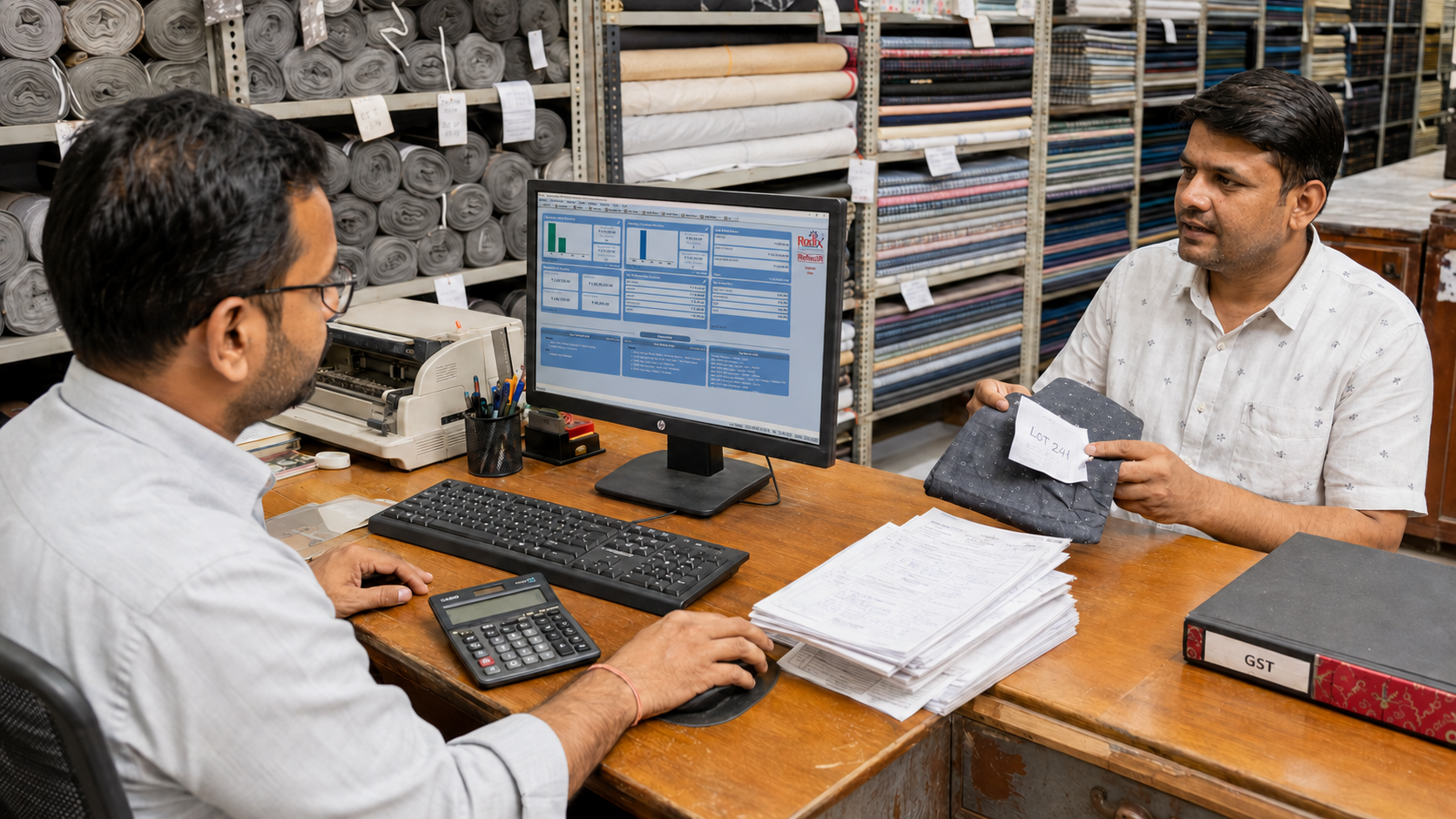
If you ask a textile business owner what keeps them awake at night, the answer is rarely “accounting.”
It is usually delayed payments, missing stock, GST reconciliation, rising yarn prices, or urgent customer deliveries. Accounting only becomes important when one of these problems affects cash flow, stock value, or compliance.
Imagine this.
A customer calls asking for 500 meters of fabric they ordered last week.
Your warehouse says the stock was dispatched.
Your sales team says the invoice is still pending.
Your accountant says the payment hasn't been received.
Three departments. Three different answers.
After two days of checking registers, WhatsApp chats, and warehouse shelves, you discover that part of the lot was sent for dyeing, another taka was shifted to a different godown, and the remaining meters were still being shown as available stock.
This is not just an inventory mistake. It is an accounting problem because the stock value, sales commitment, and receivable position are all connected.
In the textile industry, accounting isn't just about recording transactions. It's about knowing where your money is, where your stock is, and whether your business is actually making a profit.
Unlike many businesses, textile manufacturing and trading involve multiple stages before a product reaches the customer. Yarn is purchased, consumed, dyed, woven, printed, embroidered, packed, transferred between godowns, and finally sold. At every stage, the quantity and value of that inventory can change.
That's why textile accounting goes far beyond maintaining purchase and sales records.
A good accounting system should help you answer questions like the following:
If you cannot answer these questions quickly, the problem is not only missing information. It may mean that pricing, purchasing, dispatch, and GST decisions are being made on incomplete data.
Everything begins with purchasing raw materials.
Whether you're buying yarn, grey fabric, dyes, chemicals, or accessories, every purchase should be accurately recorded with supplier details, GST information, quantity, rate, and additional costs such as freight.
Even a small mistake in purchase entries can affect profitability later. For example, if freight or dyeing charges are not added to the correct lot, the fabric may look profitable on paper while the actual margin is much lower.
Inventory is often the largest investment in a textile business.
Unlike many industries, textile inventory exists in multiple forms:
Keeping accurate inventory records ensures that your financial statements reflect the actual value of your business. It also helps avoid common textile problems such as part of a lot being at dyeing, partial job-work returns not being updated, godown transfers missing from records, or taka and meter balances not matching.
Many businesses know their sales figures but struggle to calculate the actual cost of producing fabric.
A proper costing system should include the following:
Without calculating these costs properly, it is difficult to know whether you are making a healthy profit or simply generating revenue. A common example is yarn consumption not matching fabric output because wastage, conversion loss, or process rejection was never recorded against the right batch.
GST compliance remains one of the biggest operational challenges for textile businesses because purchase, sales, job work, HSN classification, and stock movement records need to stay aligned.
Different textile products may attract different GST rates, and incorrect entries can lead to notices, penalties, or blocked Input Tax Credit (ITC).
Maintaining accurate purchase, sales, expense, and job-work records makes GST filing smoother and reduces reconciliation issues. This is especially important as GST systems continue to depend on cleaner invoice data, e-invoicing applicability, and input tax credit matching for eligible businesses.
At this point, many textile businesses realize that a generic accounting setup is not enough. Tripta Accounting and Inventory Software is built specifically for textile workflows, so lot-wise tracking, job work, GST billing, stock movement, and receivables are connected in one system instead of being managed across registers, Excel sheets, and memory.
Sales don't automatically mean money in the bank.
Most textile businesses operate on credit, making it essential to track customer receivables and supplier payments.
Monitoring outstanding payments regularly helps maintain healthy cash flow and reduces financial stress.
Even experienced businesses make avoidable accounting mistakes, such as:
These mistakes usually happen because entries are delayed, stock movement is recorded separately from accounts, or too much operational knowledge stays with one person. Over time, that creates hidden costs: wrong purchase decisions, delayed dispatches, avoidable reconciliation work, and unclear margins.
Ask yourself these five questions:
If your answer is “No” to most of these questions, your accounting process may need improvement. The goal is not only to reduce manual work; it is to make sure the owner, accountant, sales team, and godown team are all looking at the same business reality.
Modern textile accounting software doesn't replace your accountant—it helps everyone in your business work with the same information.
When purchases are recorded, inventory updates automatically.
When sales are entered, stock reduces automatically.
When payments are received, customer balances update instantly.
This reduces duplicate work and makes reports more reliable. Instead of calling the godown manager to check a lot or asking the munim to remember which challan is pending, the business can see stock, billing, payments, and job-work status from the same records.
For textile businesses, this matters because accounting accuracy depends on operational accuracy. If a godown transfer is not updated, if only part of a job-work lot returns, or if meters are converted incorrectly from takas, the accounts will eventually reflect the same gap.
For example, with textile-focused accounting software like Tripta, these operational entries are connected to accounting outcomes. A lot sent for dyeing, a partial job-work return, or a godown transfer does not remain just a warehouse update; it also reflects in stock value, billing readiness, and business reports.
Running a textile business today is more challenging than ever.
Margins are tighter, customer expectations are higher, and compliance requirements continue to evolve, including GST reporting and e-invoicing obligations for businesses that meet the applicable turnover criteria.
Strong accounting won't solve every business problem, but it gives you something every successful business owner needs—clarity.
When you know exactly what you own, what you owe, what you're earning, and where your inventory stands, you can make faster and smarter business decisions.
And in today’s competitive textile industry, informed decisions are often the difference between controlled growth and constant firefighting.
If you are already reviewing your accounting process, this is where Tripta Accounting Software can fit naturally into the next step. It helps textile businesses bring accounting, inventory, job work, GST billing, and receivables into one connected system, so decisions are based on updated records instead of scattered entries.
Before you leave, answer these five questions honestly.
☐ I know my exact inventory value today.
☐ I can identify my top five overdue customers.
☐ I know the profit margin on every major product category.
☐ My physical stock matches my accounting records.
☐ My GST, e-invoicing, and ITC records are reconciled on time wherever applicable.
5/5: Your accounting foundation is strong.
3–4/5: There are opportunities to improve efficiency.
0–2/5: Your business may have hidden financial and inventory leaks that deserve immediate attention.

Leave a comment